Is Blu Atlas Hydrating Face Moisturizer good? Is Blu Atlas good for oily skin? What are the 9 ingredients in Blu Atlas moisturizer? Is Blu Atlas moisturizer good for all skin types?
Blu Atlas has built a following with a clear, confident pitch: nine ingredients, nothing wasted, no fillers. It’s a compelling angle in a market full of 40-ingredient formulas where half the list is filler. The minimalist philosophy is genuine and the transparency is refreshing. For $20, the price is honest. The brand deserves credit for all of that.
The problem is the execution. Nine ingredients is only a virtue if the right nine were chosen — and this particular lineup has a fundamental mismatch between what the formula actually does and who the brand says it’s for. The “all skin types” claim on the product page is where this review has to get specific, because the second ingredient in this formula is one of the worst possible choices for oily or acne-prone skin, and the vitamin C, while a quality derivative, is almost certainly too diluted to deliver the anti-aging and brightening results the marketing leads with.
My full review below.
Key Takeaways:
- Blu Atlas uses an admirable minimalist approach and publishes their full nine-ingredient list, which is a mark of genuine transparency. The brand philosophy is sound.
- Mango seed butter is the second ingredient in the formula — meaning it’s present at a high concentration. It is a moderately comedogenic, occlusive butter that is well-suited to dry skin but problematic for oily, combination, and acne-prone skin. The “all skin types” claim does not hold up.
- 3-O-Ethyl Ascorbic Acid is a good, stable vitamin C derivative. But it appears fifth in a nine-ingredient list, behind two heavy emollients and a botanical extract. At that position, the concentration is likely well below what research supports for meaningful brightening and anti-aging effects.
- There is no glycerin, no hyaluronic acid, no humectant of any kind beyond the seaweed extract — which means the formula hydrates primarily through occlusion rather than moisture-binding. For dry skin in winter that works. For most other contexts it’s an incomplete hydration strategy.
- At $20 for what appears to be a 2 oz jar, the price is genuinely fair and is one of the product’s clear strengths.
Table of Contents
- What is the Blu Atlas Hydrating Face Moisturizer?
- What are the 9 ingredients?
- Is Blu Atlas good for oily or acne-prone skin?
- Is the vitamin C effective?
- What’s missing from this formula?
- Is it worth $20?
- Product Review
- Pros & Cons
1. What is the Blu Atlas Hydrating Face Moisturizer?
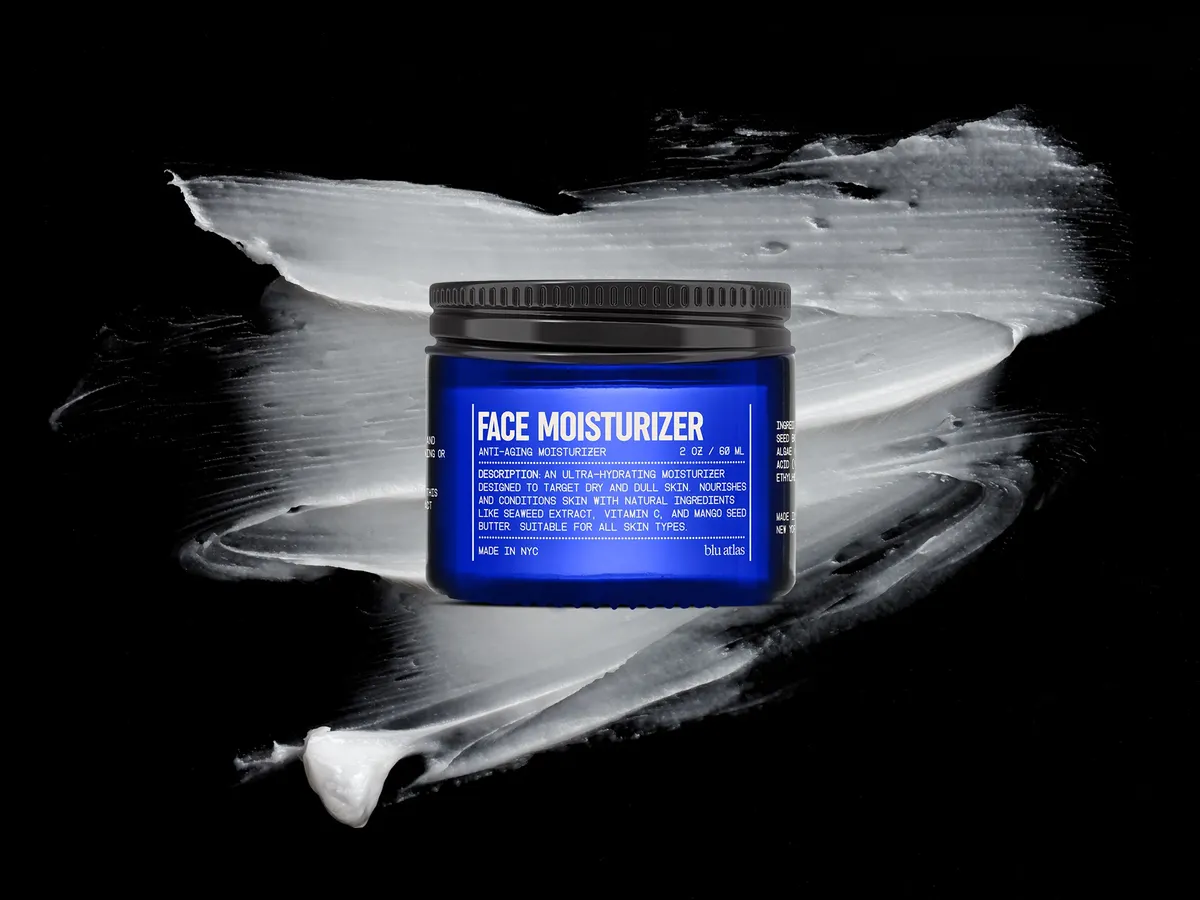
The Blu Atlas Hydrating Face Moisturizer is a daily face moisturizer built around a nine-ingredient formula — the brand’s core identity. It’s priced at $20, described as suitable for all skin types, and marketed on the strength of mango seed butter, moringa oil, seaweed extract, and a stable vitamin C derivative. The brand positions it as a clean, no-filler alternative to moisturizers with long ingredient lists full of synthetics.
The philosophy is genuinely appealing, and for a specific type of skin it probably works well. The issue is the “all skin types” positioning, which the formula doesn’t support.
2. What are the 9 ingredients?
Blu Atlas publishes their full INCI list directly on the product page, which I want to acknowledge as a good practice that not enough skincare brands follow. Here’s what’s in it:
Water (Aqua) — the base solvent.
Mangifera Indica (Mango) Seed Butter — cold-pressed from mango seeds and rich in oleic and stearic fatty acids. Mango butter is a real workhorse for dry skin: it’s nourishing, it reinforces the skin barrier, and it absorbs reasonably well for a butter. The issue is its comedogenicity rating and its occlusive nature — more on this in the next section.
Moringa Oleifera Seed Oil — a lightweight, penetrating oil high in oleic acid and behenic acid. Moringa is genuinely good skin conditioning and one of the more elegant plant oils available. It has antioxidant properties and absorbs well. Good inclusion.
Laminaria Algae (Seaweed) Extract — a humectant and antioxidant. Seaweed extract pulls moisture from the environment and binds it to the skin. Solid ingredient with real evidence for hydration support.
3-O-Ethyl Ascorbic Acid (Vitamin C) — a stabilized vitamin C derivative that converts to pure vitamin C once absorbed into the skin. The stabilization is a genuine advantage over standard ascorbic acid, which oxidizes quickly. This is a quality ingredient choice. The question, as with any active, is whether it’s present at a meaningful concentration. At position five in a nine-ingredient list, with two heavy emollients ahead of it, the answer is probably not.
Sodium Phytate — a chelating agent that binds to trace metals in the formula to prevent oxidation of the actives. It’s not doing anything for your skin directly — it’s there to keep the other ingredients stable. Necessary and sensible.
Phenoxyethanol — a globally approved preservative that prevents bacterial growth in water-based formulas. Standard inclusion.
Ethylhexylglycerin — a preservative booster that makes phenoxyethanol more effective at a lower concentration. Also a mild skin conditioner.
Natural Fragrance — the brand says no phthalates or synthetic fragrance compounds. Fair enough, though “natural fragrance” is a broad category that can still include sensitizing compounds for reactive skin.
3. Is Blu Atlas good for oily or acne-prone skin?
No — and this is the most important thing to know before buying.
Mango seed butter is the second ingredient in this formula. Position two means it is present at a high concentration — this is a butter-heavy moisturizer. Mango butter has a comedogenicity rating of 2 out of 5, which is considered moderately comedogenic. That means it has a meaningful chance of clogging pores, particularly on skin that already trends oily or congested.
Beyond comedogenicity, mango butter is occlusive — it forms a film on the skin that limits moisture loss. For dry skin, that is a feature. For oily skin, it adds another layer on top of skin that is already producing excess sebum, which can trap oil and debris and lead to breakouts.
Moringa oil is lighter and better-tolerated across skin types, but it can’t offset the fact that mango butter is the dominant ingredient after water. The overall formula character is rich, nourishing, and occlusive — exactly right for dry or very dry skin, and a potential problem for oily, combination, or acne-prone skin.
The “all skin types” claim on the product page is simply not accurate for this formula. Oily skin types should look elsewhere.
4. Is the vitamin C effective?
The 3-O-Ethyl Ascorbic Acid is a quality choice — one of the more stable and well-regarded vitamin C derivatives in skincare right now. The derivative form matters because standard ascorbic acid is notoriously unstable and can oxidize before it reaches the skin, making most vitamin C products less effective than their marketing suggests. This form doesn’t have that problem.
The issue is concentration. Research on vitamin C’s brightening and collagen-stimulating effects uses concentrations of 10–20% in most clinical studies. 3-O-Ethyl Ascorbic Acid can be effective at lower concentrations than pure ascorbic acid — but it still needs to be present at a meaningful percentage.
In this nine-ingredient formula, vitamin C sits at position five: behind water, mango seed butter, moringa oil, and seaweed extract. With only four ingredients ahead of it — two of which are the primary emollients that make up a large portion of the formula by weight — the vitamin C is likely at a low single-digit percentage at best. That’s below the threshold where you’d expect significant brightening or anti-aging benefit.
If vitamin C efficacy is a priority for you, a dedicated 10–15% vitamin C serum applied before your moisturizer will deliver far more than this product can.
5. What’s missing from this formula?
The minimalist nine-ingredient approach is a genuine design choice, not a cost-cutting measure — and I respect the philosophy. But those nine ingredients have to cover everything a daily moisturizer needs to do, and this formula has a notable gap: it doesn’t contain a classical humectant.
Glycerin and hyaluronic acid are the two workhorses of moisturizer hydration — they draw water from the environment and deeper layers of the skin into the outer layer, keeping it plump and hydrated from within. Neither is present here. The seaweed extract provides some humectant function, but it’s a botanical extract sitting fifth in the list, not a concentrated humectant.
What that means practically: this formula hydrates primarily through occlusion — mango butter and moringa oil create a barrier that slows moisture loss — rather than actively binding water to the skin. Occlusion works well for dry skin. For normal skin or in humid conditions, it’s less complete than a formula with both a humectant and an occlusive. For oily skin it’s the wrong approach entirely.
There’s also nothing here for anti-aging beyond the vitamin C — no peptides, no retinol, no niacinamide. For a $20 daily moisturizer that’s fine. But the brightening and anti-aging claims in the marketing should be read in that context.
6. Is it worth $20?
At $20 for a 2 oz jar, Blu Atlas is priced fairly — this is clearly mid-range and for the right skin type it represents good value. There’s no brand markup being disguised as ingredient quality, no luxury packaging adding phantom cost. What you’re paying for is what’s in the jar, and the brand is honest about that.
The calculus shifts depending on skin type. For dry skin, $20 for a clean, thoughtfully formulated moisturizer built around mango butter and moringa oil is a reasonable deal. The texture is pleasant, the fragrance is mild, and the vitamin C, whatever its concentration limitations, adds more than most $20 moisturizers offer.
For oily or combination skin, the $20 is a wash regardless of how low the price is — because a product that may contribute to breakouts has a cost that goes well beyond the purchase price.
7. Product Review
In use, this formula has a pleasant, substantive texture — richer than you might expect from a lightweight moisturizer claim, which is a consequence of having mango seed butter so high in the list. It absorbs within a minute or two without leaving a greasy finish, and the natural fragrance is subtle enough not to compete with anything else in your routine.
On dry skin, especially in drier months, this performs well. The butter-and-oil combination delivers genuine comfort and the skin feels genuinely nourished rather than just coated. The seaweed extract provides a slightly cooling sensation on application that’s pleasant.
On my combination skin, I noticed increased congestion in the T-zone after about two weeks of consistent use — which tracks exactly with what the ingredient list predicts. The mango butter was doing its job, just not on a skin type that needed it.
The vitamin C isn’t particularly visible in terms of brightening at this concentration over a short window. That’s an honest limitation of what a $20, nine-ingredient moisturizer can accomplish — not a knock on the formula, just an expectation calibration.
8. Pros & Cons
What I like about it: Full nine-ingredient list published directly on the page — the gold standard for transparency. $20 pricing is genuinely honest. Mango butter and moringa oil are quality ingredients that perform well on dry skin. 3-O-Ethyl Ascorbic Acid is a better vitamin C choice than most brands make. No unnecessary fillers. Vegan, paraben-free, made in the USA.
What I don’t like about it: The “all skin types” claim is inaccurate — mango seed butter at the second position makes this a problematic formula for oily and acne-prone skin. Vitamin C concentration is almost certainly too low for meaningful brightening or anti-aging efficacy. No classical humectant (glycerin or hyaluronic acid) means the hydration strategy is entirely occlusion-based, which doesn’t suit all skin types or climates. The anti-aging marketing overstates what this formula can deliver at this concentration.
Who it’s for: Men with dry to normal skin who want a clean, minimalist moisturizer with quality ingredients at an honest price. If you have dry skin and want to know exactly what you’re putting on your face, this delivers.
Who should skip it: Men with oily, combination, or acne-prone skin — the mango butter base is a likely congestion trigger. Men who are buying primarily for vitamin C brightening or anti-aging effects — the concentration isn’t there.
SHOP: Blu Atlas Hydrating Face Moisturizer — $20 at bluatlas.com
The Bottom Line
Blu Atlas deserves credit for what they’ve built: a clean, honest, minimalist moisturizer at a fair price, with every ingredient justified and the full list published upfront. That’s genuinely rare in the men’s skincare space, and it matters.
The formula has a real skin type problem, though. Mango seed butter at this concentration is not a good fit for oily or acne-prone skin, and the brand’s decision to market this to “all skin types” does a disservice to the customers it doesn’t work for. A more accurate positioning — dry and normal skin, particularly in drier climates or months — would help buyers make an informed decision.
The vitamin C is a quality choice but almost certainly underdosed relative to what clinical research supports. If you’re buying this specifically for brightening or fine line reduction, temper those expectations.
For dry skin at $20, though? It’s a genuinely solid option in a category full of over-engineered formulas. The minimalist philosophy, executed correctly for its actual audience, would earn a real endorsement.
Full Ingredient List — Blu Atlas Hydrating Face Moisturizer:
Water (Aqua), Mangifera Indica (Mango) Seed Butter, Moringa Oleifera Seed Oil, Laminaria Algae (Seaweed) Extract, 3-O-Ethyl Ascorbic Acid (Vitamin C), Sodium Phytate, Phenoxyethanol, Ethylhexylglycerin, Natural Fragrance