Is Brickell Men’s anti-aging cream worth it? What are the ingredients in Brickell anti-aging cream? Is Brickell good for sensitive skin? Is Brickell anti-aging cream good for oily skin?
Brickell Men’s Products has been around since 2014 and built a loyal following on the strength of a clear, simple pitch: natural and organic ingredients, no toxic synthetics, formulated specifically for men. It’s a brand with genuine credibility in the men’s natural skincare space, and the Revitalizing Anti-Aging Cream is their flagship night moisturizer. It sells for around $45 for 2 oz and appears regularly in round-ups from GQ, Men’s Health, and Men’s Journal.
When you actually read the ingredient list, though, the picture gets complicated. The formula has real strengths — it’s genuinely hydrating and the base is well-constructed for dry skin. But the “all skin types” positioning doesn’t hold up, the essential oils in the scented version are a concern for sensitive skin, and several of the headline marketing ingredients either aren’t in the formula at all or appear at concentrations too low to do much.
One thing worth addressing upfront: Brickell’s marketing leans heavily on the idea that conventional skincare is “filled with toxic, synthetic chemicals” and that natural ingredients are inherently safer and more effective. This framing is worth pushing back on. “Toxic” is a word that requires a dose and a context — water is toxic at the wrong dose. The synthetic preservatives and emulsifiers that natural skincare brands position as villains are, in most cases, some of the most thoroughly safety-tested ingredients in the industry, approved by regulators across the EU, US, and Japan at concentrations shown to be safe over decades of use.
Meanwhile, natural doesn’t mean safe or gentle. The essential oils in Brickell’s scented formula — eucalyptus, peppermint, lemongrass — are natural, organic, and among the most common causes of contact dermatitis in skincare. Poison ivy is natural. Arsenic is natural. The natural/synthetic binary is a marketing framework, not a safety framework, and treating it as one leads people to trust products that irritate their skin and distrust ingredients that are well-studied and well-tolerated.
Preferring natural and organic formulations is a legitimate personal choice. Just don’t conflate “natural” with “safe for sensitive skin” or “more effective” — because on both counts, this ingredient list argues otherwise.
My full review below.
Key Takeaways:
- Brickell’s Revitalizing Anti-Aging Cream is built on a rich, oil-and-butter-heavy base that delivers effective hydration for dry skin — but makes it a poor fit for oily, combination, and acne-prone skin types despite the “all skin types” claim.
- The scented version contains three essential oils (eucalyptus, peppermint, and lemongrass) positioned at the end of the list. These are among the most common causes of contact dermatitis in skincare. The brand recommends this product for sensitive skin — that recommendation and these ingredients don’t belong in the same sentence.
- DMAE is listed as a key marketing ingredient on product pages and in press coverage, but it does not appear in the INCI list. What’s being marketed is not necessarily what’s in the jar.
- Sodium hyaluronate appears at position 24 out of 29 ingredients — near the bottom of the formula and likely at a low concentration.
- Alcohol (ethyl alcohol) appears at position 23, which is unexpected in an anti-aging night cream and potentially drying.
- At $45 for 2 oz, this is mid-to-high pricing for a formula without niacinamide, ceramides, or peptides.
Table of Contents
- What is the Brickell Revitalizing Anti-Aging Cream?
- What are the ingredients — and what’s missing?
- Is Brickell good for oily or acne-prone skin?
- Is the scented version safe for sensitive skin?
- What about the DMAE and MSM claims?
- Where does the hyaluronic acid actually sit?
- Is it worth $45?
- Product Review
- Pros & Cons
1. What is the Brickell Revitalizing Anti-Aging Cream?
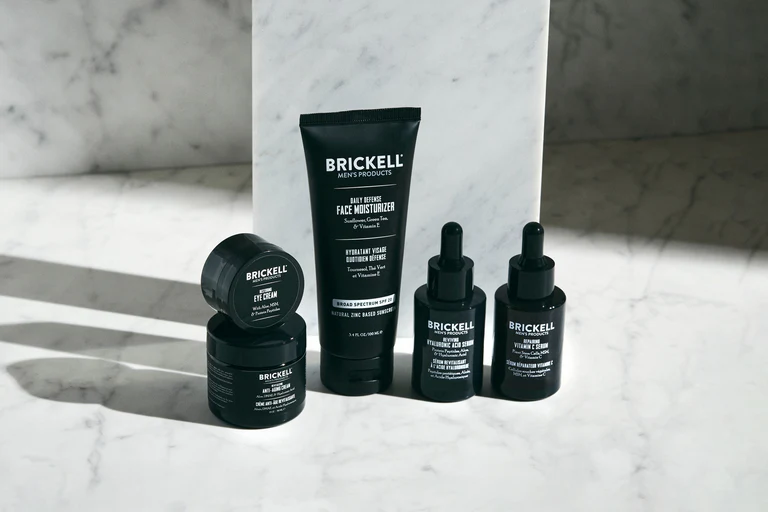
The Brickell Revitalizing Anti-Aging Cream is the brand’s hero nighttime moisturizer — positioned as a natural, organic anti-aging cream for men of any age with any skin type. It’s available in scented and unscented versions ($45 for 2 oz), and the brand markets it on the strength of DMAE, MSM, hyaluronic acid, and green tea as key actives.
The natural and organic credentials are real — the brand is certified and the INCI list reflects that commitment. What’s less clear is whether the natural ingredients chosen deliver on the anti-aging claims, and whether the formula actually works for everyone it’s marketed to.
2. What are the ingredients — and what’s missing?
Full INCI list:
Aloe Barbadensis Leaf Juice (Aloe), Aqua (Deionized Water), Helianthus Annuus Seed Oil (Sunflower), Ethylhexyl Palmitate, Glycerin, Glyceryl Stearate, Cocos Nucifera Oil (Coconut), Butyrospermum Parkii Butter (Shea Butter), Maranta Arundinacea Root Powder (Arrowroot Powder), Theobroma Cacao Seed Butter (Cocoa), Beeswax, Cetyl Alcohol, Potassium Stearate, Simmondsia Chinensis Seed Oil (Jojoba), Phenoxyethanol, Dimethyl Sulfone (MSM), Sodium Carbomer, Ethylhexylglycerin, Panthenol (Vitamin B5), Oenothera Biennis Oil (Evening Primrose), Rosa Canina Fruit Oil (Rosehip Seed), Salix Alba Bark Extract (Willow Bark), Tocopheryl Acetate (Vitamin E), Alcohol, Sodium Hyaluronate, Camellia Sinensis Leaf Extract (Green Tea), Usnea Barbata Extract, Eucalyptus Globulus Leaf Oil, Mentha Piperita Leaf Oil, Cymbopogon Flexuosus Oil (Lemongrass).
Aloe Barbadensis Leaf Juice — the base liquid, rather than standard purified water. Aloe has soothing and anti-inflammatory properties and is a reasonable opening choice for a natural formula.
Aqua — supporting the aloe base.
Helianthus Annuus Seed Oil (Sunflower Oil) — position three, meaning it’s present at a meaningful concentration. A light emollient with a good fatty acid profile. Better tolerated by oily skin than some heavier oils, but it’s still an oil that sits on the skin.
Ethylhexyl Palmitate — a lightweight emollient ester that aids spreadability.
Glycerin — position five. A solid humectant that draws moisture into the skin. One of the formula’s cleaner, better-positioned actives.
Glyceryl Stearate — an emulsifier that helps the formula hold together.
Cocos Nucifera Oil (Coconut Oil) — position seven. Coconut oil has a comedogenicity rating of 4 out of 5 — among the highest of any common skincare ingredient. For dry skin it’s a fine emollient. For acne-prone or oily skin, it’s one of the more reliably pore-clogging ingredients available. More on this below.
Butyrospermum Parkii Butter (Shea Butter) — position eight. Rich, occlusive, good for dry skin. Moderately comedogenic.
Maranta Arundinacea Root Powder (Arrowroot Powder) — a natural thickener and absorbent. Helps the formula feel less greasy on application.
Theobroma Cacao Seed Butter (Cocoa Butter) — position ten. Another occlusive butter with a comedogenicity rating of 4. Two ingredients in the top ten with a rating of 4 is a meaningful concern for anyone who isn’t dry-skinned.
Beeswax — position eleven. Occlusive, helps the formula’s texture and water-resistance. Reinforces the overall rich character of this formula.
Cetyl Alcohol — a fatty alcohol that acts as an emollient and thickener.
Jojoba Seed Oil — a waxy ester that absorbs reasonably well. Better-tolerated than most oils, but adds to the overall emollient load.
Panthenol (Vitamin B5) — a humectant and soothing ingredient with good evidence for skin barrier support. A quality supporting active.
Evening Primrose and Rosehip Seed Oil — both are rich in essential fatty acids, particularly linoleic acid, which has evidence for improving skin barrier function. They’re at positions 20 and 21 — present but not dominant.
Willow Bark Extract — contains salicin, a natural salicylate. Some mild exfoliating and anti-inflammatory activity. Not equivalent to salicylic acid at clinical concentrations, but a reasonable addition.
Tocopheryl Acetate (Vitamin E) — antioxidant. Standard and appropriate.
Alcohol — position 24. Ethyl alcohol in an anti-aging night cream is a flag. In a formula this rich with emollients, the alcohol is likely being used as a solvent or to thin the texture, but it’s still a potentially drying ingredient in a product designed to hydrate and repair overnight.
Sodium Hyaluronate — position 25 out of 29. At the bottom quarter of the formula. At this position the concentration is almost certainly low — more of a marketing badge than an active ingredient at meaningful levels.
Green Tea Extract — antioxidant, reasonable inclusion.
Eucalyptus, Peppermint, and Lemongrass Essential Oils — the last three ingredients in the scented version. More on these below.
What’s not in the formula: No niacinamide. No ceramides. No peptides. No retinol or retinoid. No vitamin C. These are the ingredients with the strongest clinical evidence for anti-aging in moisturizers. The Brickell formula relies instead on plant oils, butters, botanical extracts, and MSM — a natural approach, but one that lacks the targeted anti-aging actives that drive results in the research literature.
3. Is Brickell good for oily or acne-prone skin?
No. The “all skin types” claim on the product page is not supported by the ingredient list.
Coconut oil at position seven has a comedogenicity rating of 4/5. Cocoa butter at position ten has a rating of 4/5. Shea butter and beeswax are both moderately occlusive. Together, the top ten ingredients of this formula paint a clear picture: this is a rich, emollient-heavy night cream formulated for dry skin. It works as intended for that audience.
For oily, combination, or acne-prone skin, two ingredients with a comedogenicity rating of 4 in the top half of the formula present a real breakout risk. The arrowroot powder provides some mattifying effect on application, but it doesn’t offset the occlusive nature of the oils and butters underneath.
The unscented version would be the better choice if you’re determined to try Brickell — fewer irritants — but the formula’s overall character makes it a poor match for oily skin regardless.
4. Is the scented version safe for sensitive skin?
The brand recommends this product for sensitive skin. The scented version contains eucalyptus, peppermint, and lemongrass essential oils as its final three ingredients.
These three essential oils are among the most common triggers for contact dermatitis in skincare. Peppermint contains menthol, which can cause irritation and sensitization. Eucalyptus and lemongrass both contain compounds — cineole, geraniol, citral — that are established skin sensitizers at concentrations used in cosmetics. The tingling sensation that some reviewers describe positively (“I can feel it working”) is, in many cases, low-grade irritation.
For truly sensitive skin — reactive, rosacea-prone, or eczema-prone — these essential oils are a meaningful concern. The unscented version avoids them entirely and is a better product for that skin type. If sensitive skin is your profile, the scented version isn’t the right choice regardless of other merits.
5. What about the DMAE and MSM claims?
The brand’s product descriptions and marketing materials highlight DMAE (dimethylaminoethanol) as a key anti-aging ingredient. It does not appear in the INCI list. This is worth flagging plainly: if DMAE is being marketed as a key active in a product you’re considering buying, it should be in the ingredient list of that product.
MSM (dimethyl sulfone) does appear at position 16. MSM is a sulfur-containing compound that’s used in supplements and topical products, marketed for joint health, anti-inflammatory effects, and skin benefits. The topical skincare research on MSM is limited and the evidence for meaningful anti-aging benefit at concentrations used in cosmetics is thin. It’s a natural ingredient with some plausibility, but the research doesn’t support the prominent role it plays in Brickell’s marketing.
Neither DMAE nor MSM has the clinical evidence base of niacinamide, retinol, ceramides, or peptides — which don’t appear in this formula at all.
6. Where does the hyaluronic acid actually sit?
Sodium hyaluronate appears at position 25 out of 29 ingredients. In a formula where coconut oil is at position seven and shea butter is at position eight, the relative concentrations tell a clear story: this is predominantly an oil-and-butter moisturizer with hyaluronic acid added near the bottom. The amount present is unlikely to deliver meaningful humectant hydration. The hydration in this formula comes from the emollient base, not from hyaluronic acid drawing moisture into the skin.
That’s not inherently a problem for dry skin — emollient hydration through occlusion works perfectly well. But the marketing emphasis on hyaluronic acid as a key active deserves calibration against where it actually sits in the formula.
7. Is it worth $45?
At $45 for 2 oz, Brickell is priced at around $0.75 per ml — mid-to-high range for a men’s daily moisturizer. At that price point, you’d reasonably expect a formula with clinical anti-aging actives: niacinamide, ceramides, peptides, or retinol. What you’re getting instead is sunflower oil, coconut oil, shea butter, cocoa butter, and beeswax — a hydration profile that works well for dry skin but doesn’t deliver the targeted anti-aging ingredients that justify the price for anyone buying primarily for wrinkle reduction.
The unscented version at the same price is a better product — no essential oil irritation risk. But for $45, you’re paying for natural sourcing and organic certification, not for a clinically stacked anti-aging formula. That’s a legitimate value proposition for some buyers, but it should be understood as what it is.
8. Product Review
On dry skin, this cream delivers on the hydration promise. The texture is rich — more balm-like than cream — and it sinks into the skin over a few minutes, leaving a comfortable, non-greasy finish thanks partly to the arrowroot powder. It wears well overnight and skin feels noticeably softer and more comfortable the next morning. For men who find standard moisturizers too light for dry or very dry skin, especially in cold weather, the formula profile is appropriate.
The scented version produces a noticeable tingle on application, primarily from the peppermint and eucalyptus. This reads as freshness to some users and irritation to others — that split in perception is itself telling. If your skin reacts to the tingle with redness or persistent sensitivity, that’s the essential oils at work and the unscented version is the right choice.
Visible anti-aging results — reduction in fine lines, improved firmness — would require more time and realistic expectations. The formula hydrates well, and adequate hydration does temporarily plump fine lines. But without retinol, niacinamide, or peptides, the long-term anti-aging mechanism is primarily the result of consistent hydration rather than targeted cellular-level treatment.
9. Pros & Cons
What I like about it: Aloe-based formula with a solid humectant and emollient structure. Effective hydration for dry skin. Organic certification is real and reflects genuine sourcing standards. Panthenol, evening primrose, and rosehip oil are quality supporting ingredients. Unscented version avoids the essential oil concerns. The brand’s natural positioning is consistent and not just marketing language. Available in unscented.
What I don’t like about it: Coconut oil and cocoa butter at positions seven and ten — two ingredients with a comedogenicity rating of 4 — make this unsuitable for oily or acne-prone skin despite the “all skin types” claim. Three essential oils in the scented version (eucalyptus, peppermint, lemongrass) are established sensitizers that contradict the recommendation for sensitive skin. DMAE is marketed as a key ingredient but doesn’t appear in the INCI list. Sodium hyaluronate at position 25 is unlikely to deliver meaningful humectant activity. Alcohol at position 23 is unexpected in an anti-aging night cream. No niacinamide, ceramides, peptides, or retinol — the ingredients with the strongest clinical evidence for anti-aging.
Who it’s for: Men with dry to very dry skin who prioritize natural and organic formulations and want a rich nighttime moisturizer. The unscented version is the better purchase for anyone with sensitive or reactive skin who still wants to try the brand.
Who should skip it: Men with oily, combination, or acne-prone skin. Men with sensitive skin buying the scented version. Men primarily shopping for clinically active anti-aging treatment — this formula isn’t built for that.
SHOP: Brickell Men’s Revitalizing Anti-Aging Cream — $45 for 2 oz at brickellmensproducts.com
The Bottom Line
Brickell is a brand that means what it says about natural and organic ingredients — the formula reflects the commitment. For dry skin in a cold climate, this is a comfortable, effective night moisturizer that does what an emollient-heavy formula should do.
The problems are the gaps between the marketing and the reality. The “all skin types” claim doesn’t hold up against two comedogenicity-4 ingredients in the top ten. The scented version’s essential oils don’t belong near sensitive skin. DMAE is prominently marketed and not in the formula. The hyaluronic acid and anti-aging claims outrun what the ingredient list actually supports at the concentrations present.
If you have dry skin and want a natural night cream, the unscented version is worth considering. If you’re buying this specifically for anti-aging efficacy — measurable reduction in lines, improved firmness, clinical-level treatment — there are better-formulated options at this price point.
Full Ingredient List — Brickell Men’s Revitalizing Anti-Aging Cream (Scented):
Aloe Barbadensis Leaf Juice (Aloe), Aqua (Deionized Water), Helianthus Annuus Seed Oil (Sunflower), Ethylhexyl Palmitate, Glycerin, Glyceryl Stearate, Cocos Nucifera Oil (Coconut), Butyrospermum Parkii Butter (Shea Butter), Maranta Arundinacea Root Powder (Arrowroot Powder), Theobroma Cacao Seed Butter (Cocoa), Beeswax, Cetyl Alcohol, Potassium Stearate, Simmondsia Chinensis Seed Oil (Jojoba), Phenoxyethanol, Dimethyl Sulfone (MSM), Sodium Carbomer, Ethylhexylglycerin, Panthenol (Vitamin B5), Oenothera Biennis Oil (Evening Primrose), Rosa Canina Fruit Oil (Rosehip Seed), Salix Alba Bark Extract (Willow Bark), Tocopheryl Acetate (Vitamin E), Alcohol, Sodium Hyaluronate, Camellia Sinensis Leaf Extract (Green Tea), Usnea Barbata Extract, Eucalyptus Globulus Leaf Oil, Mentha Piperita Leaf Oil, Cymbopogon Flexuosus Oil (Lemongrass)
Unscented version omits the final three essential oils.