Kiehl’s has always been an interesting brand to me, and was my first foray into what I considered “fancy” skincare. I was gifted a blue Kiehl’s set in high school, like most people I know. After I started getting into skincare, and getting more educated about formulations, I realized “lab branding” for Kiehl’s is unfortunately more branding than science.
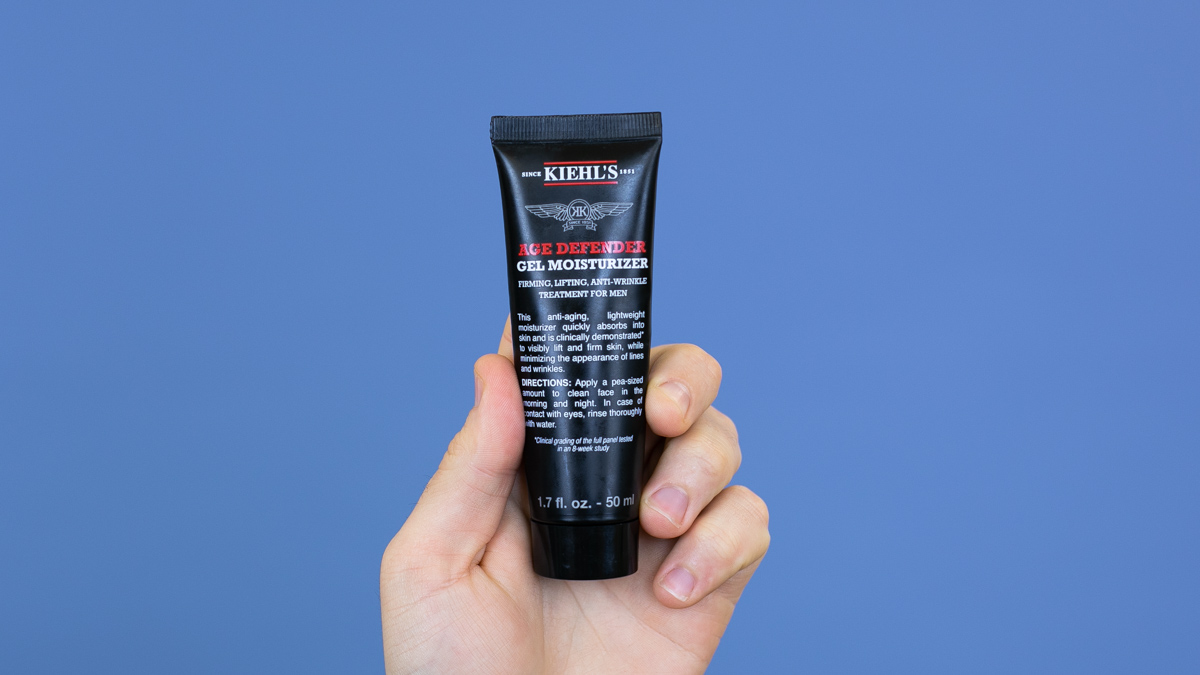
I’m on the lookout for the best anti-aging moisturizer for men and wanted to try to see if this Kiehl’s men’s moisturizer is better than the blue “Fuel” line that is more entry level. The Age Defender Cream Moisturizer is their men’s anti-aging product, marketed as “clinically-demonstrated” to firm and lift skin. It runs about $57 for 2.5 oz.
I’ll be direct about this one: it’s one of the more disappointing formulas I’ve reviewed once you measure the ingredient list against the price and the marketing. The “firming and lifting” effect users notice is mostly a cosmetic illusion created by film-forming agents. The fourth ingredient is denatured alcohol, in a product meant to protect and repair skin. And the actual anti-aging actives sit so far down the list that their real-world impact is questionable.
Key Takeaways
- Denatured alcohol is the fourth ingredient. At this position in an anti-aging moisturizer, it’s a problem: it breaks down your skin barrier and can leave skin drier, working against the product’s own stated purpose.
- The “firming and lifting” sensation comes mainly from Polyurethane-2 and Synthetic Wax, film-forming agents that create a temporary mechanical tightening effect. That’s not an anti-aging mechanism, and it wears off.
- Three fragrance-related ingredients are present (Parfum, Limonene, and Linalool), with the latter two flagged as established contact allergens.
- The marketed hero actives (Capryloyl Salicylic Acid, Linseed Extract, Caffeine, Ascorbyl Glucoside, Adenosine) all sit in the bottom half of a 46-ingredient list.
- No niacinamide, ceramides, hyaluronic acid, peptides, or retinol. The ingredients with the strongest anti-aging evidence are simply absent from this formula.
- At $57 for 2.5 oz, you’re paying mostly for the Kiehl’s name and the in-store experience, not the ingredient list.
Table of Contents
- What Is The Kiehl’s Age Defender Cream Moisturizer?
- What Are The Ingredients?
- Why Is Denatured Alcohol In An Anti-Aging Moisturizer?
- What’s Actually Causing The “Firming” Effect?
- What About The Fragrance And Allergens?
- Where Are The Actual Anti-Aging Actives?
- Is It Worth $57?
- Product Review
- Pros & Cons
1. What Is The Kiehl’s Age Defender Cream Moisturizer?
This is the one Kiehl’s puts front and center for men’s anti-aging: marketed as clinically demonstrated to visibly lift and firm skin and soften fine lines, built with men’s thicker skin in mind, meant to go on morning and night. The three ingredients Kiehl’s leads with in their own marketing are Capryloyl Salicylic Acid, Linseed Extract, and Caffeine.
Kiehl’s is owned by L’Oréal at this point, so there’s serious money and R&D behind the name. Going through this formula, though, that backing doesn’t really show up in what’s actually in the jar.
2. What Are The Ingredients?
Full INCI list: Aqua/Water, Glycerin, Dimethicone, Alcohol Denat., Sucrose Stearate, Orbignya Oleifera Seed Oil, Pentaerythrityl Tetraethylhexanoate, Poly C10-30 Alkyl Acrylate, Theobroma Cacao Seed Butter, Hydrogenated Polyisobutene, Octyldodecanol, Stearic Acid, Palmitic Acid, Synthetic Wax, Sodium Polyacrylate, Phenoxyethanol, Capryloyl Salicylic Acid, Parfum/Fragrance, Polyurethane-2, Acrylates/C10-30 Alkyl Acrylate Crosspolymer, Polymethyl Methacrylate, Chlorphenesin, Xanthan Gum, Sodium Hydroxide, Limonene, Hydrolyzed Linseed Extract, Dimethiconol, Tocopherol, Caffeine, Pentaerythrityl Tetra-Di-T-Butyl Hydroxyhydrocinnamate, Glycine Soja Protein, Myristic Acid, Ascorbyl Glucoside, Adenosine, Vaccinium Myrtillus Fruit Extract, Sodium Benzoate, Caprylyl Glycol, Dimethyl Mea, Saccharum Officinarum Extract, Sodium Cocoyl Glutamate, Linalool, Ethylhexylglycerin, Sodium Dehydroacetate, Citrus Aurantium Dulcis Fruit Water.
The first few minutes I spent going through this list, I actually thought it was decent. Glycerin at position two is the kind of boring, reliable ingredient you want to see near the top. It pulls moisture into skin and just works. Dimethicone right after it is why the cream feels so smooth going on. No complaints there.
Then position four is denatured alcohol, and that’s where I stopped and had to sit with it for a second. More on why that matters below.
Scrolling further down, the formula leans on Theobroma Cacao (cocoa) Seed Butter for richness, which is nice for dry skin but can clog pores on anyone oilier. Something to keep in mind if you break out easily. Synthetic Wax shows up around position fourteen, and that’s a piece of the “firming” puzzle I’ll get into in a minute.
What actually stopped me, though, was scrolling past all three of the marketed hero ingredients (Capryloyl Salicylic Acid, Linseed Extract, and Caffeine) and realizing how far down the list they all sit. Capryloyl Salicylic Acid doesn’t show up until position seventeen. Linseed Extract is at twenty-six. Caffeine’s at twenty-nine. In a list of 46 ingredients, that’s deep into the bottom half, which almost always means a low, likely token concentration.
Then there’s the fragrance situation: Parfum shows up at eighteen, and Limonene and Linalool are called out separately later in the list, which happens specifically because EU regulation requires disclosure once fragrance allergens cross a certain concentration. That’s three separate fragrance-related entries in one formula, on a product meant for skin that already tends to get more sensitive with age.
And the vitamin C, Ascorbyl Glucoside, tucked in at thirty-three, is one of the weaker forms available. It needs your skin to do two separate conversion steps before it becomes usable vitamin C. Adenosine, right after it at thirty-four, actually has decent research behind it for wrinkles, but by that point in the list, don’t expect much from the concentration.
3. Why Is Denatured Alcohol In An Anti-Aging Moisturizer?
This is the part that actually bothered me the most going through this formula.
Denatured alcohol isn’t automatically a red flag. I’ve used plenty of toners and lightweight serums where a little alcohol helps everything absorb fast and finish clean, and that’s a fair tradeoff in that context. But it’s the fourth ingredient here. That’s not a trace amount doing a small job; that’s a significant share of the formula.
And this is a moisturizer marketed to protect and repair skin, applied daily, morning and night. Use something like that day after day and it starts wearing down your skin’s natural barrier, the thing that’s supposed to keep moisture in and irritants out. Over time that means drier skin, more sensitivity, and skin that’s working harder to protect itself. Which is more than a little ironic in a product sold specifically to fight the signs of aging, since a compromised barrier is part of what makes skin look older and more worn out in the first place. This isn’t a fringe take. It’s something dermatologists bring up consistently.
My guess is the alcohol’s there for the finish, that fast-absorbing, non-greasy feel a lot of guys reach for. And on that front, it works. It’s just working against the skin underneath while it does it.
4. What’s Actually Causing The “Firming” Effect?
Here’s the part of this formula I actually find kind of clever, in a slightly frustrating way.
That tight, lifted feeling you get after applying this isn’t coming from anything biological. It’s Polyurethane-2 and Synthetic Wax, two film-forming ingredients that sit on top of skin and physically pull tight as they dry. It’s the exact same trick as a peel-off face mask. You feel it happen live: apply, wait a couple minutes, and skin noticeably firms up.
You can feel it, so in that sense it’s not fake. It’s just not doing anything to the actual structure of your skin. No collagen stimulation, nothing changing at a cellular level. It’s a plastic film contracting on the surface, and once it comes off (sweat, washing your face, just enough time passing), the tightness goes with it. What Kiehl’s calls “clinically-demonstrated to visibly lift and firm skin” is, as far as I can tell, mostly measuring that film’s effect on how light bounces off your face, not anything actually changing underneath.
This isn’t a Kiehl’s-only trick, either. It shows up across the category. But at $57, I think it’s worth knowing the lift you’re feeling is mechanical, not something happening inside your skin.
5. What About The Fragrance And Allergens?
This formula has Parfum sitting at position eighteen, and then further down, Limonene and Linalool get called out on their own. That’s not an accident or redundancy. Brands have to list those two separately once they’re present above a certain amount, specifically because they’re known to cause reactions in some people.
So the fact that they’re broken out at all is basically the formula telling on itself. Three separate fragrance-related entries in one moisturizer is more than I’d expect, and the more you use something like this, the more likely a reaction becomes over time, not less.
That matters more here because skin tends to get more reactive as it ages, and fragrance is consistently one of the biggest causes of irritation in skincare generally. If your skin runs sensitive or reactive at all, three fragrance ingredients, two of them flagged allergens, is enough for me to say think twice before making this your daily moisturizer.
6. Where Are The Actual Anti-Aging Actives?
Kiehl’s builds the whole marketing pitch around three hero ingredients: Capryloyl Salicylic Acid, Linseed Extract, and Caffeine. So I went and found exactly where each one sits in the list, and it’s not a great look.
Capryloyl Salicylic Acid comes in at position 17. Linseed Extract is at 26. Caffeine’s at 29. Ascorbyl Glucoside, their vitamin C, is at 33, and Adenosine, which actually has the best research behind it of the bunch, doesn’t show up until 34.
In a formula with 46 total ingredients, everything from 17 to 34 is living in the bottom half. That’s not where you find ingredients doing the heavy lifting. The first ten spots, where the real concentration is, belong to dimethicone, alcohol, a handful of emollients, and cocoa butter. None of those are anti-aging actives. They’re texture and moisture ingredients.
And there’s a whole list of proven anti-aging ingredients that just aren’t here at all: no niacinamide, no ceramides, no hyaluronic acid, no retinol, no peptides. These are the ingredients with the strongest track record for daily moisturizers, and this formula skips every single one of them.
7. Is It Worth $57?
I ran the math on this one: $57 for 2.5 oz works out to roughly $0.76 per ml, which is right in line with what I’d expect at this shelf position. That part isn’t the issue.
The issue is what you’re actually getting for it. Formulas I’d put in the same price range usually have their real actives sitting higher on the list, don’t lead with denatured alcohol, and aren’t relying on a plastic film to fake the results. Here, you’re mostly paying for the Kiehl’s name and the experience of standing at their counter getting a consultation, which, fair enough, is worth something to some guys. It’s just not what the ingredient list is giving you.
8. Product Review
When I put this on, I get the appeal right away. It goes on smoothly, the dimethicone gives it that silky finish, and within a few minutes I could feel the tightening kick in as the polyurethane-2 film set. Looking in the mirror right after, skin noticeably looks smoother, and it absorbs fast with zero greasy residue.
That’s the formula doing exactly what it was built to do. It’s just a surface trick, not actual treatment.
Over a few weeks of daily use, I’d expect guys with sensitive or reactive skin to start noticing some redness or irritation, most likely from the fragrance or the ongoing toll the alcohol takes on the barrier. If your skin runs oily, keep an eye on the cocoa butter too. And the tell that gave the whole thing away for me: skip a day or two, and the “firming” disappears with it. If it were doing something structural, it wouldn’t vanish that fast.
9. Pros & Cons
What works: glycerin at position two is a solid humectant. Adenosine has legitimate peer-reviewed anti-aging evidence. Babassu oil is a quality lightweight emollient. The immediate texture on application is pleasant. The in-store consultation experience is a genuine advantage if you’re evaluating products in person.
What doesn’t: denatured alcohol at position four undermines the product’s own purpose. The “firming” effect comes from film-forming polymers, not biological mechanisms. Three fragrance-related ingredients, two of them flagged allergens. Ascorbyl Glucoside is one of the weaker vitamin C derivatives available. No niacinamide, ceramides, hyaluronic acid, or peptides. The marketed actives sit in the bottom half of a 46-ingredient list. Cocoa butter at position nine is a comedogenicity concern for oily skin. The price reflects the brand more than the formula.
Who it’s for: men who want the Kiehl’s in-store experience and like the immediate texture feel, and who understand they’re paying primarily for brand and sensation rather than clinical anti-aging performance.
Who should skip it: men with sensitive, reactive, or oily skin, and anyone buying primarily for anti-aging efficacy.
SHOP: Kiehl’s Age Defender Cream Moisturizer, approximately $57 for 2.5 oz at kiehls.com
The Bottom Line
Going through this one, what I kept coming back to is that it’s a well-packaged product from a respected brand that leans on film-forming polymers and denatured alcohol to create a convincing short-term sensory experience that doesn’t reflect what’s actually happening to skin over time. The firming feels convincing because a plastic film is physically tightening against your face. The smooth finish feels good because dimethicone is an excellent texture ingredient. When you wash it off, nothing underneath has changed.
For me, denatured alcohol as the fourth ingredient is the single most damaging detail here: a barrier disruptor sitting inside a product meant to protect and repair the barrier. Add three fragrance allergens, the absence of every well-established anti-aging active, and hero ingredients buried at positions 17 through 34, and I don’t think the formula justifies $57 on its own merits.
Kiehl’s makes better products than this one. For men’s anti-aging specifically, this is a product that looks the part at the counter without delivering what the label promises.
Overall Rating: 4/10
Full Ingredient List: Kiehl’s Age Defender Cream Moisturizer
Aqua/Water, Glycerin, Dimethicone, Alcohol Denat., Sucrose Stearate, Orbignya Oleifera Seed Oil, Pentaerythrityl Tetraethylhexanoate, Poly C10-30 Alkyl Acrylate, Theobroma Cacao Seed Butter, Hydrogenated Polyisobutene, Octyldodecanol, Stearic Acid, Palmitic Acid, Synthetic Wax, Sodium Polyacrylate, Phenoxyethanol, Capryloyl Salicylic Acid, Parfum/Fragrance, Polyurethane-2, Acrylates/C10-30 Alkyl Acrylate Crosspolymer, Polymethyl Methacrylate, Chlorphenesin, Xanthan Gum, Sodium Hydroxide, Limonene, Hydrolyzed Linseed Extract, Dimethiconol, Tocopherol, Caffeine, Pentaerythrityl Tetra-Di-T-Butyl Hydroxyhydrocinnamate, Glycine Soja Protein, Myristic Acid, Ascorbyl Glucoside, Adenosine, Vaccinium Myrtillus Fruit Extract, Sodium Benzoate, Caprylyl Glycol, Dimethyl Mea, Saccharum Officinarum Extract, Sodium Cocoyl Glutamate, Linalool, Ethylhexylglycerin, Sodium Dehydroacetate, Citrus Aurantium Dulcis Fruit Water